

Sunglasses Buying Guide: 9 Practical Tips You Should Know
Nov 18, 2026
Leave a message

Sunglasses are not only an important accessory for daily outfits, but also a crucial tool for protecting eyes during outdoor activities. Whether it's for daily commutes, beach vacations, driving, or outdoor sports, choosing the right pair of sunglasses is very important. When faced with products of different materials, lens colors, and functions, how should consumers make a judgment? Here are several key factors to consider when purchasing sunglasses.
- 1. Prioritize 100% UV protection
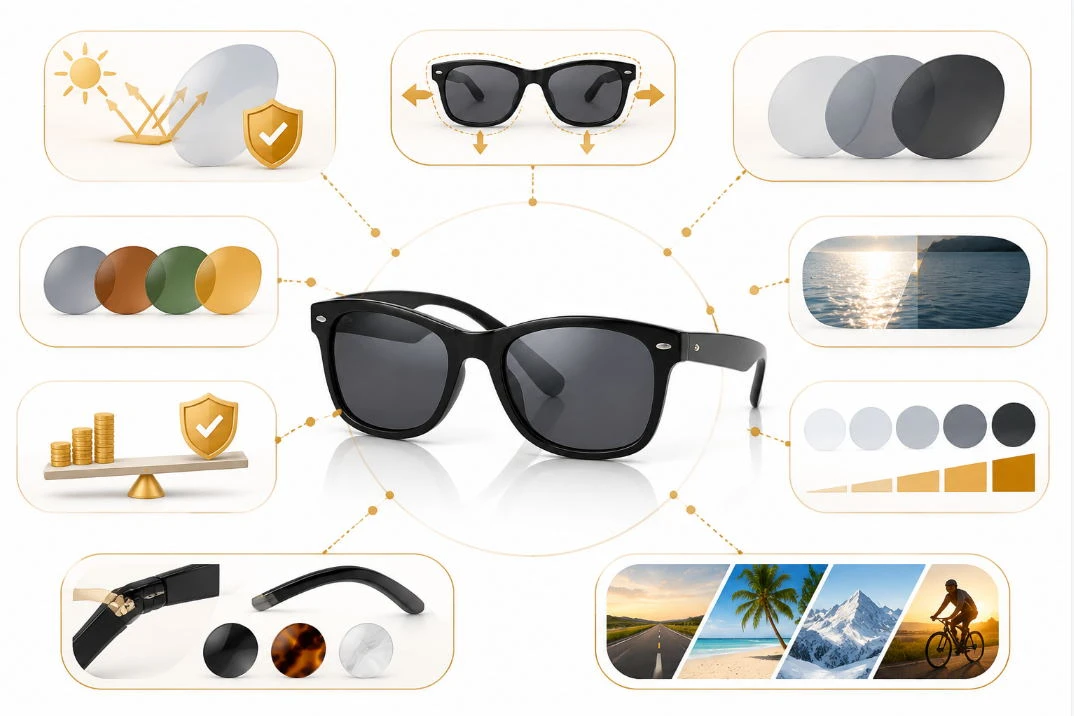
When choosing sunglasses, the first thing to consider is the UV filtering ability of the lens. It is recommended to choose products labeled with 100% UVA and UVB protection, or UV400. There is no direct relationship between UV protection and the color depth of the lens. You cannot judge the protection effect solely based on appearance.
- 2. Choose larger frame coverage
The size of the frame also affects the actual protection range of sunglasses. Larger lenses and frame designs that cover the sides of the eyes can reduce sunlight exposure from different directions. Wide frames, square frames, and wraparound sunglasses are all worthy of consideration.
- 3. Don't assume that darker lenses mean better protection
Dark lenses are mainly used to reduce visible light entering the eyes and do not necessarily mean stronger UV protection. What really matters is whether the lens has the required UV filtering performance. When purchasing, check the product labels and test reports instead of just focusing on the lens color.
- 4. Lens color affects visual experience
Different colors of lenses bring different visual sensations. For example, gray lenses usually help maintain a more natural color representation; brown and amber lenses can enhance contrast in certain environments; green lenses are also a common choice for outdoor sunglasses. For scenarios that require accurate traffic signal recognition, special attention should be paid to whether the lens causes significant color distortion.

- 5. Understand the function of polarized lenses
Polarized lenses can filter some reflected glare from flat surfaces such as roads and water, improving visual comfort in strong light environments, especially for driving, fishing, and outdoor activities.
It should be noted that polarized function does not equal UV protection. When purchasing, also confirm whether the lens has sufficient UV protection capability.
- 6. Price does not necessarily represent protection quality
High-priced sunglasses do not necessarily mean better UV protection performance. Consumers should judge based on lens technology, product materials, manufacturing processes, and actual test results. Some moderately priced sunglasses can also meet the corresponding UV protection requirements.
For purchasers, they should also consider product quality, material costs, function configuration, and target market price positioning, rather than simply judging product value based on the price.
- 7. Understand the lens protection grade of sunglasses
Sunglasses are usually classified into 0 to 4 categories based on visible light transmission. Different grades are suitable for different light environments:
0 category: Lens color is lighter, suitable for indoor or low-light environments, with limited shading ability.
1 category: Suitable for weak sunlight environments.
2 category: Suitable for moderate sunlight environments.
3 category: Suitable for strong sunlight environments, a common outdoor sunglasses grade.
4 category: Suitable for very strong light environments, such as mountains and ice environments, not suitable for driving.
Note that the lens protection grade mainly reflects the level of visible light transmission and does not equal UV filtering ability.
- 8. When purchasing, also pay attention to the comfort of the frame and wearing
In addition to lens functions, the material of the frame, weight, nose pad structure, and frame design also affect the daily wearing experience. Different materials have different characteristics, such as PC material being lightweight, TR90 having good flexibility, and acetate fiber having rich texture and texture. Consumers can choose appropriate products based on usage scenarios and personal needs.

- 9. Choose sunglasses based on the actual usage scenario
The requirements for sunglasses vary depending on the activity. For daily commuting, a classic and lightweight style can be chosen; when driving, attention should be paid to the glare control and light transmission performance of the lenses; for fishing, cycling, and outdoor activities, the selection should take into account the lighting environment, the stability of the frame, and the functions of the lenses. Clearly defining the usage needs is more important than simply pursuing trendy styles.
- Conclusion
When choosing the right sunglasses, one needs to consider factors such as UV protection, lens color, polarized function, protection level, frame material, and wearing comfort. Whether for individual consumers or for purchasing agents in the eyewear industry, understanding these basic principles can help make more reasonable product selections.
As the sunglasses market continues to grow, consumers' demands for product functions, design, and quality are also increasing. For brand owners, retailers, and wholesale purchasers, choosing products that can balance material quality, lens performance, and design features will help meet the demands of different markets.